Organic Mattress Materials
Organic Latex Mattress Construction: Dunlop, Layers, and Support
A mattress is not a single material so much as a considered composition: a resilient core, softer comfort layers, and the textile envelope that meets the body. Understanding how those elements are assembled can make the language of organic latex mattresses easier to navigate—and help separate meaningful material details from a well-polished label.
Organic latex has a distinctive reputation in the world of sleep materials. It is associated with buoyant support, an elastic response and, depending on the construction, a more natural-material profile than many conventional foam mattresses. Yet the words “organic latex” do not tell the whole story. A mattress can use latex in one layer or throughout its core; it can be made with different latex processes, different firmnesses and a range of cotton, wool or synthetic components around it.
Construction is where those differences become tangible. The thickness and placement of each layer affect how the bed responds when you lie down, how readily it cushions pressure, and whether it feels gently yielding or distinctly supportive. Material disclosure and certification, meanwhile, help clarify which parts of the mattress are actually organic or independently assessed. For an informed comparison, look beyond the headline claim and consider the complete assembly.
This guide explains Dunlop latex, layered designs, support and the role of natural fibers. It is not a promise that one construction suits every sleeper. Comfort is personal, and certifications answer specific questions rather than guaranteeing a particular sleep experience.
What “organic latex mattress” can—and cannot—mean
Latex used in bedding is commonly made from rubber-tree sap, though latex products may also contain synthetic rubber or blends. When a mattress is described as organic, it is important to establish what that word applies to. It may refer to the latex foam itself, the cotton used in a cover, wool in a fire barrier, or a particular combination of certified components. A broad product description is not a substitute for a clear breakdown.
Natural, organic and certified are not interchangeable terms. “Natural” can describe the source of a material, but does not by itself establish how it was grown, processed or tested. Organic certification concerns defined requirements and scope. A certificate may apply to a raw material, a processing facility or a finished product, depending on the standard and the claim being made. Ask what is certified, who issued the certification, and whether the product’s exact materials and manufacturing chain are covered.
That distinction matters because a mattress is a composite object. Its latex core might be certified while the cover, thread, adhesive or other components have different origins. Conversely, a textile certification may cover a fabric without making claims about the latex beneath it. A careful disclosure names the components and avoids suggesting that one credential automatically speaks for every part of the bed.
For consumers comparing organic mattress materials, the most useful question is often a simple one: “Which specific layer does this claim describe?” A reliable answer should identify the material, its location in the mattress, and the relevant certification or technical specification where applicable.
Dunlop latex: a core with substance
Dunlop is a method of producing latex foam. In broad terms, liquid latex is whipped into a froth, placed in a mold, heated to set, and then washed and dried. The resulting foam is commonly described as dense and resilient. In a mattress, a Dunlop latex core may serve as the main support layer, while thinner layers above it adjust the surface feel.
It is tempting to treat the name of a process as a complete forecast of comfort, but it is only one part of the picture. The final feel also depends on the foam’s firmness, thickness, density, shape and position in the mattress. The cover and any wool or cotton layers contribute to the first impression, too. Two mattresses made with Dunlop latex can therefore feel notably different.
Latex is elastic: it compresses under pressure and tends to spring back rather than remaining slowly molded around the body in the manner associated with some memory foams. That lively response can make repositioning feel easier for some people. It does not mean that every latex bed is firm, nor does it establish that latex will relieve pain or suit a particular medical need. Those outcomes cannot be guaranteed by a material name alone.
When a manufacturer lists a Dunlop core, look for information about its depth and firmness, and whether the core is one continuous piece or part of a layered arrangement. If a mattress is described as having multiple latex layers, ask whether they are the same firmness or deliberately varied. Specifics make it easier to understand the design beyond a general promise of natural comfort.
How mattress layers shape the feel
A useful way to read mattress construction is from the surface down. The uppermost material creates the first sensation: smooth, quilted, soft, springy or firm. Beneath it, comfort layers distribute pressure and influence how the mattress accommodates shoulders, hips and other points of contact. The support core provides the deeper resistance that helps limit excessive sinking. In a latex mattress, those functions can be delivered by one substantial latex layer or by several layers with different characteristics.
More layers do not automatically mean better construction. A multi-layer design can allow a manufacturer to tune the feel or replace individual components, but its value depends on the materials, their thickness, how they are joined and how clearly their specifications are disclosed. A single latex core with natural-fiber layers can also be a coherent design. Evaluate the structure rather than counting layers as a shortcut for quality.
Consider what each layer is meant to do. A softer upper latex layer may provide more give; a firmer layer beneath it can contribute a more stable base. Wool may add a light cushioning quality and help manage moisture, while cotton commonly appears in the cover or ticking. These fibers influence the surface and the overall material profile, but they do not replace the need to understand the mattress’s core.
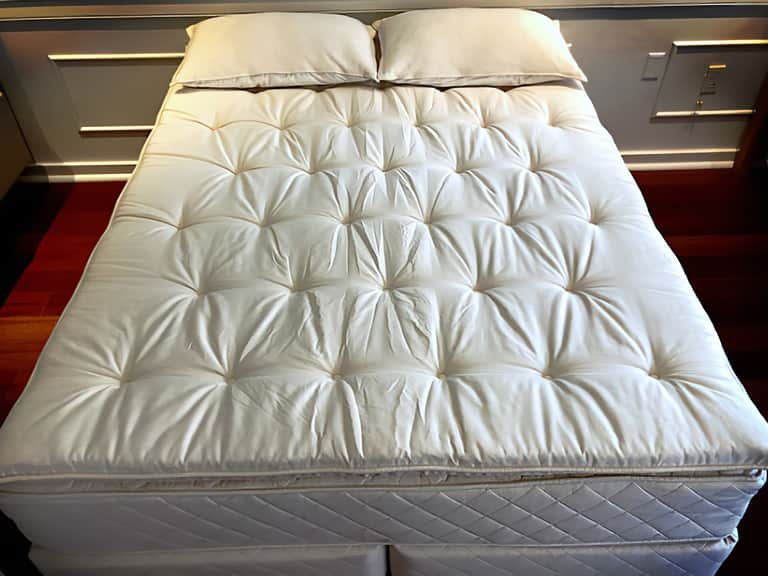
Some latex products are sold as toppers rather than mattresses. A topper changes the surface of an existing bed but does not provide a complete support system on its own. For example, the Naturally Organic Hudson Organic Mattress Topper is described as a two-inch layer of organic latex between organic wool, finished with an organic cotton sateen cover. That is an example of a latex-and-natural-fiber layer, not a substitute for assessing the mattress beneath it. Its effect will depend on the condition and firmness of the underlying mattress, as well as the sleeper’s preferences.
Support is a construction question—and a personal one
Support is often used as a catch-all word, but it is helpful to distinguish it from firmness. Firmness describes the initial impression of the surface, while support concerns how the mattress responds under the body. A bed can feel relatively plush at the surface while maintaining a firmer core; another can feel firm from the first moment without necessarily matching every sleeper’s preferred alignment.
Body shape, sleep position, personal comfort preferences and the mattress base all influence the experience. Side sleepers may pay close attention to how a surface accommodates the shoulder and hip. Back and stomach sleepers may be more sensitive to the degree of sink through the torso. These are general considerations, not rules: individuals vary, and labels such as “side sleeper” do not determine a single correct mattress.
Construction details can help narrow a comparison, but they cannot predict exactly how a mattress will feel to a particular person. A firm rating from one maker may not be directly comparable with another maker’s scale. If possible, review a clear trial and return policy, warranty terms and care instructions before making a decision. For adjustable beds, check that the mattress is explicitly compatible with the base and follow the maker’s guidance about bending, weight distribution and frame support.
Also consider the foundation. Latex mattresses need a stable, appropriately spaced support system, and manufacturer instructions should take precedence over general advice. A suitable base can help the mattress perform as designed; an incompatible or uneven foundation may affect comfort and longevity regardless of the quality of the materials.
Cotton, wool and the details around the core
Natural fibers can be integral to a mattress’s construction, not merely decorative finishing touches. Cotton commonly forms a cover or ticking, the fabric layer that encloses the mattress. Its weave, finish and thickness influence the hand of the surface and how readily it moves with the layers underneath. If organic cotton is an important criterion, verify whether the certification applies to the cover fabric, the full textile assembly or another defined part.
Wool may be used as a cushioning layer, an insulating material or part of a fire-barrier strategy. It can absorb and release moisture, and its presence may alter the surface feel. However, wool is not a universal solution for temperature comfort, and the amount and placement matter. Ask whether the wool is certified, how it has been processed and whether it is combined with other materials.
Mattresses also contain elements that are less visible in a product photograph or a short headline: thread, zippers, adhesives, quilt layers and barriers. These can affect the total material picture. A complete disclosure should identify major components and clarify any blended or synthetic materials rather than relying on an all-natural impression.
There is no need to assume that a natural material is automatically preferable for every person or use. Allergies, sensitivities, care expectations and budget all matter. Anyone with a diagnosed allergy or a specific health concern should seek advice from a qualified professional and check the full material information directly with the manufacturer.
Reading certifications without overreading them
Certifications can lend useful structure to a complicated supply chain, but each one has a defined scope. GOLS is associated with organic latex and establishes requirements for certified materials and processing within its certification framework. GOTS addresses organic fibers and textile processing. OEKO-TEX Standard 100 concerns testing of textiles and components for certain harmful substances under its criteria; it is not, on its own, proof that a material is organic.
These distinctions are useful precisely because they prevent one mark from being asked to prove everything. A textile standard and a latex standard address different parts of a mattress. A finished-product claim should be supported by documentation that matches the claim, while a component certificate should be described as applying to that component.
Certification names can change in detail over time, and standards may be revised. For current verification, consult the certification body’s own public resources or ask the manufacturer for the relevant certificate and its scope. Check the product name, material, facility and certificate validity where that information is available. A logo on a general brand page is less informative than documentation tied to the actual product or component in question.
Look for precise language rather than sweeping assurances. Useful disclosure answers what a layer is made of, whether it is blended, how it is processed and which certification applies. If a company uses terms such as “chemical-free,” request clarification: all physical materials consist of chemicals, and the phrase does not identify a specific test, restricted substance list or certification.
Durability, care and the life of a latex mattress
Durability is shaped by the quality and design of the core, the way layers are assembled, how the mattress is supported and how it is used. Latex’s resilience is one reason it is valued in mattress construction, but no material is immune to wear. Compression, surface changes and wear to the cover can develop over time. A manufacturer’s warranty describes certain covered conditions; it is not a guarantee that the mattress will feel unchanged for its entire lifespan.
Care instructions should be read before the first night, particularly for mattresses with natural-fiber layers. Some covers are removable and washable; others are not designed to be taken off. Moisture, heat and direct sunlight can affect materials, so avoid improvised cleaning methods. Use only care products and procedures approved by the manufacturer, and consider a breathable protector if it is compatible with the mattress.
Rotation may be recommended for some designs, while flipping may be unsuitable for a mattress with a defined top and bottom. Follow product-specific instructions rather than assuming that every mattress should be turned on a fixed schedule. The same caution applies to lifting and moving a latex core, which can be heavy and flexible.
Longevity also has an environmental dimension. A well-maintained mattress that remains comfortable for a longer period may reduce the frequency of replacement, but disposal and recycling options vary by location and construction. Before buying, ask whether the manufacturer provides repair, replacement-layer or end-of-life guidance, and check local services rather than assuming a mattress can be recycled through ordinary collection.
A practical checklist for comparing organic latex mattresses
When product descriptions begin to blur together, return to a few concrete questions. They bring attention back to construction, evidence and usability without asking a single label to make the decision for you.
- What is the core? Confirm whether it is Dunlop latex, another type of latex foam, a blend or a combination of materials.
- How is the mattress layered? Look for the order, thickness and intended role of each major layer.
- What does the firmness description mean? Ask how the rating is measured and whether it is a subjective scale or a stated specification.
- Which components are organic? Separate claims about latex, cotton, wool and the finished mattress.
- What certification applies? Match each credential to the material and scope it actually covers.
- Are blended materials disclosed? Check for synthetic components, adhesives, barriers and other major elements.
- Is the mattress compatible with your base? Confirm slat spacing, adjustability and other foundation requirements with the maker.
- What are the care and warranty terms? Review cleaning, rotation, trial, return and warranty conditions before purchase.
A useful comparison table can be as simple as four columns: core material, layer arrangement, certification scope and care requirements. Add firmness and thickness where those details are available. This modest exercise often reveals meaningful differences more clearly than a list of lifestyle adjectives.
A quieter, clearer way to choose
The appeal of an organic latex mattress is not one feature in isolation. It is the possibility of choosing a resilient foam core, carefully specified natural fibers and a supply chain described with enough precision to be checked. Dunlop identifies a production method, not a universal feel. Layers influence pressure response and surface character, but their count alone does not establish quality. Certification can substantiate particular material claims, provided its scope is understood.
Start with the construction that is actually documented. Read the specification as a material map: what lies beneath the cover, what each layer contributes, and which claims apply to which components. Then weigh those facts against the qualities that matter in your room—comfort, support, ease of care, compatibility with the bed base and the clarity of the return policy.
In a category often dressed in expansive promises, specificity is its own kind of luxury. A well-explained mattress does not need to suggest that it is perfect for everyone. It needs to show what it is made of, how it is assembled and what a purchaser can reasonably expect from each part.